
✋ Understanding Congenital & Acquired Hand Deformities: Causes, Care, and Treatment
Our hands are central to how we interact with the world—from grasping a pencil to offering a handshake. But for some individuals, hand deformities—whether present at birth or developed over time—can make everyday tasks difficult and impact self-confidence. Fortunately, advances in reconstructive hand surgery and therapy offer hope for restoring both form and function.
👶 What Are Congenital Hand Deformities?
Congenital hand deformities are conditions that develop in the womb and are present at birth. These can occur as isolated issues or as part of a syndrome and range from mild to severe.
Common Congenital Deformities:
- Syndactyly: Fingers are fused together by skin and sometimes bone. It’s the most common congenital hand condition.
- Polydactyly: Extra digits may appear on the thumb, pinky, or center of the hand.
- Radial Club Hand: A condition where the radius bone is underdeveloped or missing, causing the wrist to curve inward.
- Thumb Hypoplasia: A thumb that is underdeveloped or absent.
- Cleft Hand: A central gap in the hand where one or more fingers are missing.
- Camptodactyly: A fixed flexion deformity, usually in the little finger.
Causes:
- Genetic mutations
- Chromosomal syndromes (e.g., Holt-Oram, Apert syndrome)
- Unknown in many cases
⚠️ What Are Acquired Hand Deformities?
Acquired hand deformities develop after birth due to injury, disease, or repetitive use. They can affect bones, tendons, joints, nerves, and skin.
Common Causes:
- Trauma: Fractures, crush injuries, burns, or tendon lacerations can lead to deformities if not properly treated.
- Arthritis: Rheumatoid arthritis and osteoarthritis can lead to joint destruction, causing deformities like swan-neck or boutonnière.
- Nerve Injuries: Damage to the ulnar, median, or radial nerves can result in claw hand, ape hand, or wrist drop.
- Dupuytren’s Contracture: Thickening of tissue under the palm skin causes fingers to bend inward.
- Stroke or Cerebral Palsy: Can result in muscle imbalances or spastic deformities.
🔬 Diagnosis & Evaluation
A full evaluation includes:
- Physical examination of hand function and appearance
- Imaging (X-rays, MRI, CT) to assess bones and soft tissue
- Genetic or neurological testing (in congenital or systemic cases)
- Functional assessment to determine how the deformity impacts daily activities
🛠️ Treatment Options
🧑⚕️ Non-Surgical Approaches
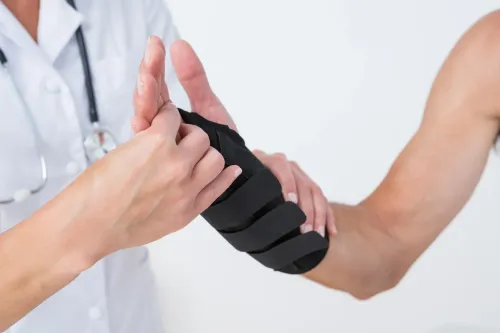
- Splinting: To correct positioning or prevent progression
- Physical and occupational therapy: Improve function, strength, and range of motion
- Steroid injections or medications: For inflammation or early arthritis
🔧 Surgical Treatments
- Reconstructive surgery: Tailored to correct anatomy and restore movement
- Tendon transfers: Redirect healthy tendons to restore function after nerve injuries
- Bone or joint realignment
- Microsurgery: For nerve repair or free tissue transfer
- Skin grafts or flaps: For soft tissue coverage after injury
🧒 Pediatric Considerations:
- Early surgery for congenital deformities can optimize growth and hand use.
- Parental involvement and therapy are key to successful outcomes.
💪 Rehabilitation & Recovery
Rehabilitation is crucial. Post-surgical care often includes:
- Custom splinting
- Scar management
- Range-of-motion and strength exercises
- Adaptive strategies for daily activities
A certified hand therapist (CHT) plays a vital role in helping patients regain independence.
🌟 Quality of Life Matters
Living with a hand deformity—whether from birth or later in life—can affect more than just function. It can also impact:
- Self-esteem
- Social interaction
- Employment and hobbies
- Mental health
That’s why care plans often include psychosocial support and long-term follow-up.
Keywords