Pins and needles after sleeping awkwardly can disappear within minutes. Repeated numbness that wakes you at night, occurs while driving, or appears during prolonged phone use may need a closer look.
Carpal Tunnel Syndrome is one possible cause, but not every numb or tingling hand has carpal tunnel syndrome.
What Makes Carpal Tunnel Syndrome Different?
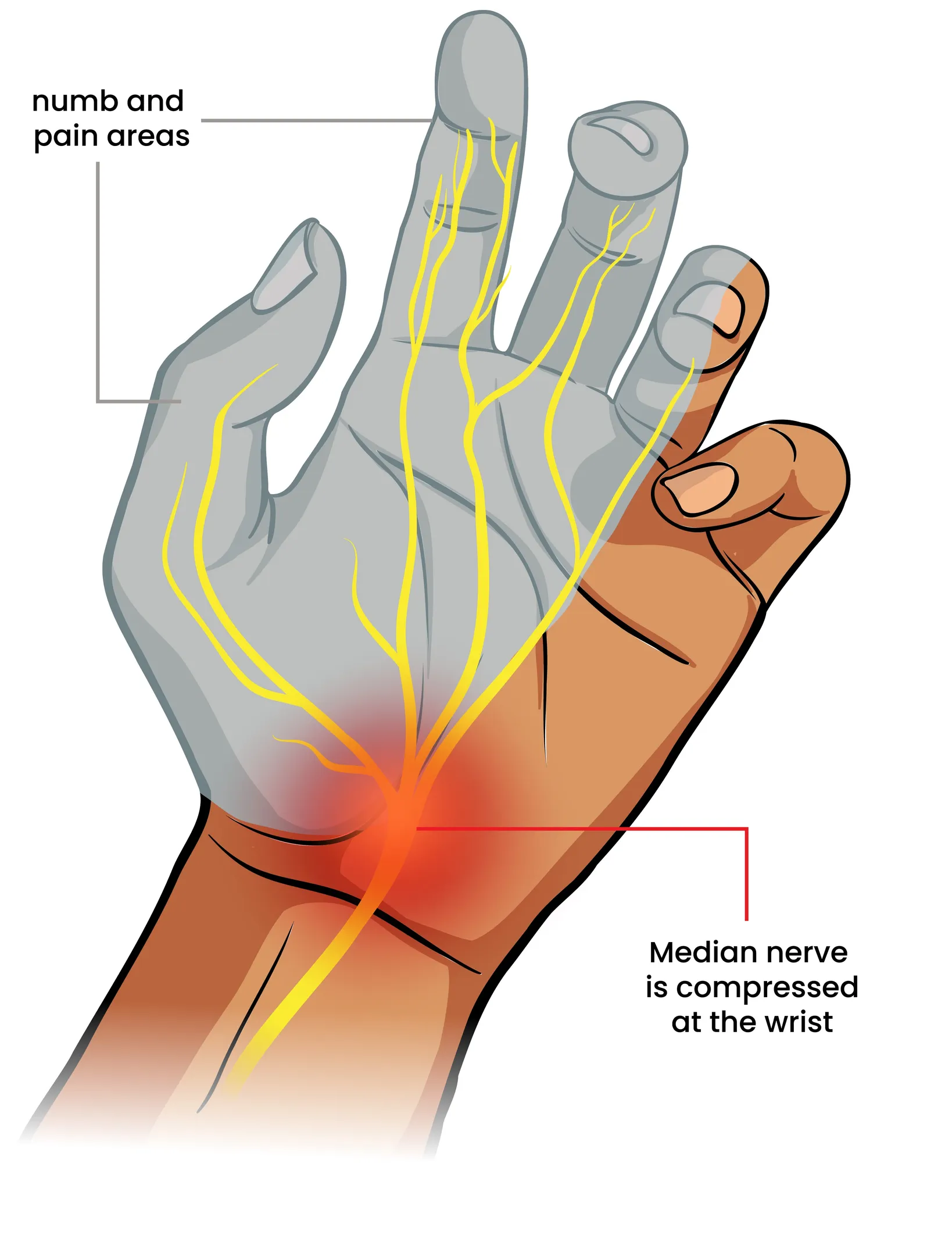
The carpal tunnel is a confined space at the wrist through which the median nerve and several tendons pass. Pressure on the median nerve can produce characteristic symptoms.
Patients commonly describe tingling or numbness involving the thumb, index, middle, and part of the ring finger. Symptoms may be more noticeable at night.
Some people shake their hand to obtain temporary relief.
As the condition progresses, patients may notice difficulty with fine tasks, reduced grip or pinch strength, or a tendency to drop objects.
Could the Numbness Have Another Cause?
Yes. Nerve symptoms can originate at different points along the upper limb. Conditions involving the neck, elbow, wrist, or peripheral nerves may produce overlapping complaints.
This makes the distribution of numbness, accompanying pain, muscle weakness, and examination findings important.
Questions Worth Asking Yourself
Before an appointment, consider:
- Which fingers become numb?
- Does numbness wake you from sleep?
- Do driving or prolonged wrist positions trigger symptoms?
- Are you dropping objects more frequently?
- Is there neck or arm pain as well?
- Have symptoms become progressively more frequent?
These details can help differentiate between possible causes.
How Is Carpal Tunnel Syndrome Evaluated?
Clinical assessment includes sensation, muscle function, symptom distribution, and specific examination findings. In some cases, nerve conduction studies may be advised to assess nerve function and severity.
Management depends on the individual situation. Wrist positioning, night splinting, activity modification, and other non-operative measures can be suitable in selected cases. Persistent, severe, or progressive nerve compression may lead to consideration of carpal tunnel release surgery.
People working across Prabhadevi's corporate, healthcare, retail, creative, and industrial sectors often perform repetitive hand activities, but repetitive work alone should not be assumed to be the diagnosis.
Dr Nikita Shetty Orthopaedic Surgeon assesses hand numbness and suspected carpal tunnel syndrome by considering the symptom pattern, examination findings, and investigations where required.
The important distinction is between occasional temporary tingling and persistent nerve symptoms. When numbness repeatedly interrupts sleep, affects hand function, or is accompanied by weakness, identifying the actual source of nerve compression becomes increasingly important.
Keywords