A finger that catches, clicks, or becomes temporarily stuck during bending and straightening can make surprisingly simple tasks difficult. Holding a cup, using a phone, cooking, writing, or gripping a steering wheel may become uncomfortable.
This condition is commonly known as Trigger Finger.
Why Does a Finger Start Catching?
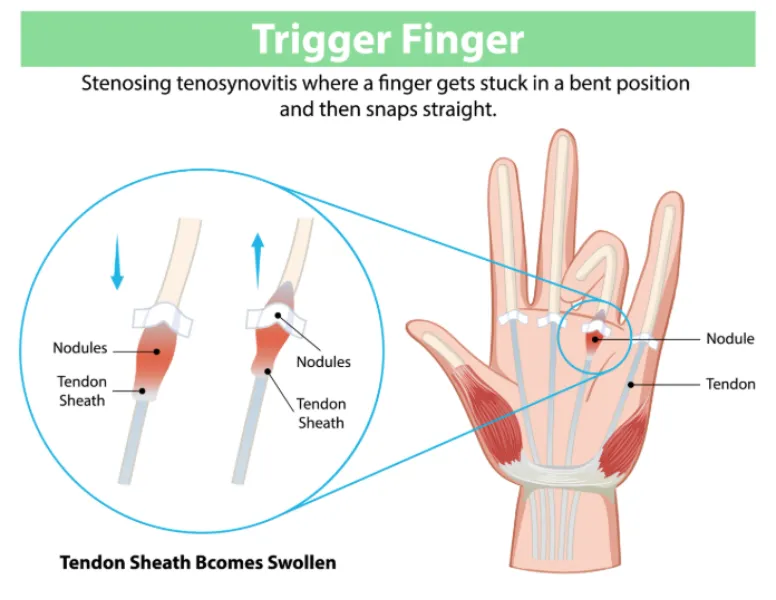
Finger movement depends on tendons gliding smoothly through a series of supporting structures. When a flexor tendon and its surrounding sheath become irritated or thickened, smooth movement can be disrupted.
The finger may initially feel stiff or tender near its base. Later, clicking or catching can occur. In more advanced cases, the finger may lock in a bent position and require assistance to straighten.
Mild and Persistent Cases Need Different Approaches
Treatment depends on the duration and severity of symptoms.
For mild cases, modifying activities that repeatedly aggravate the finger may help. Splinting is sometimes used to reduce triggering, and medical management can be considered based on the patient's condition.
A corticosteroid injection may be considered for suitable patients. Its appropriateness depends on individual factors and should be discussed after clinical evaluation.
When Is Surgery Considered?
Surgery is not automatically the first treatment for trigger finger.
A trigger finger release may be discussed when locking or painful triggering persists despite suitable conservative treatment, symptoms significantly interfere with daily activities, or the condition has progressed to a stage where normal movement is difficult.
The purpose of the procedure is to create sufficient space for the tendon to glide more freely.
What Should Patients Compare Before Choosing Treatment?
Rather than choosing solely between 'injection or surgery,' consider:
- How long the symptoms have been present
- Whether the finger actually locks
- Severity and frequency of pain
- Previous treatments and their response
- Effect on work and daily tasks
- Associated medical conditions
- Whether more than one finger is affected
These factors can influence the treatment pathway.
For Worli residents, the practical impact can be substantial. A chef, surgeon, craftsperson, office worker, musician, or machine operator may experience very different limitations from the same condition.
At Dr Nikita Shetty Orthopaedic Surgeon, trigger finger assessment considers both the mechanical problem and the functional difficulties experienced by the patient.
Early clicking does not necessarily mean surgery will be needed. Conversely, repeatedly ignoring a finger that locks or progressively loses movement may allow stiffness to become more troublesome. A clinical assessment can establish the severity of the condition and help determine whether observation, conservative treatment, injection, or surgical release is appropriate.
Keywords